Tracey Rogers Brandt
I see the connections early, and then I build the thing that makes them real.
The through-line across thirty years isn't an industry. It's a way of working: read the signal early, weave together the people who don't yet know they belong together, and build the infrastructure that makes it hold.
My technology career started in fourth grade. G.H. Whitcomb Elementary, Clear Lake City, Texas, 1979 — NASA down the road, and a DOS prompt in the classroom. My father was a programmer there; among other things he worked on the shuttle's robotic arm and on Skylab. I grew up assuming that the interesting part of any system is the part nobody can see.
The paid career started in advertising. In 1993 I was at an agency on the Audi of America account. By 1995 I was in Chapel Hill working on Red Hat and on baby bell accounts in the years after the AT&T breakup — which is where I learned that infrastructure decisions made quietly determine what becomes possible a decade later. By 1998 I was in San Francisco on the Microsoft account, then at Snowball.com, where the affiliate advertising revenue model was being invented and I built ChickShops, the first ecommerce site connected to it, three years before Google launched its own.
Then TransactPlus, where I was UX product manager on a PKI-compliant transaction delivery network built within JP Morgan's $800 billion worldwide business. Two decades before anyone said blockchain, and with no market yet for what we'd made.
Then September 11th. JP Morgan was a New York firm; our industry was in those towers. Colleagues lost people on planes and in the building. The work stopped, along with much of the world it had been built for, and I went to France.
That was the first hard left. There would be one more.
I studied natural winemaking with Eric Texier in the Rhône, and in 2004 cofounded Donkey & Goat in Berkeley, where I spent nineteen years as general manager, chief marketing officer and lead winemaker — making food-friendly, lower-alcohol natural wine when high alcohol and heavy extraction were what won scores. I wrote our manifesto in 2009: pick early, wild yeast, no additives, wood vats, no plastic. Almost none of that was a marketing position then. Most of it is table stakes now.
I also did the work nobody assigned me — cofounding the East Bay Vintners Alliance, starting Berkeley Made Libations, then taking an early bet on a derelict industrial block and spending a decade recruiting the neighbors and building the association that turned it into a district. That case study is here.
Climate didn't arrive as a topic
It arrived as smoke. My first wildfire-impacted vintage was 2008. Then 2013. Then 2017, 2018, 2020, 2021 and 2022. Seven vintages where the question wasn't how good the wine would be but whether the fruit was worth picking at all.
After 2021 I joined one of my growers in working with the Wine Institute on a gap nobody owned: growers and winemakers on one side, the labs testing for smoke impact on the other, and almost no crop insurance in between. We started closing it. We didn't finish.
After nineteen years and seven of those vintages, I'd concluded that the problem I actually cared about wasn't going to be solved in a bottle. I finished my run at the winery in 2023 and went looking for where it could be. That autumn I found John Fullerton's Capital Institute and Cohort 4 of the Regenerative Economics program, which is where the second hard left began. The work since then is here.
What I found outside
I didn't set out to rewild anything. I went outside because it was the only thing that let me show up for my children the way I wanted to. Hours of building and planting and creating, using nature's treasures and salvaged materials. Add in some string lights, seating under trees, and a strip of unused ground with a little whimsy becomes a pocket park for families and high schoolers and workers.
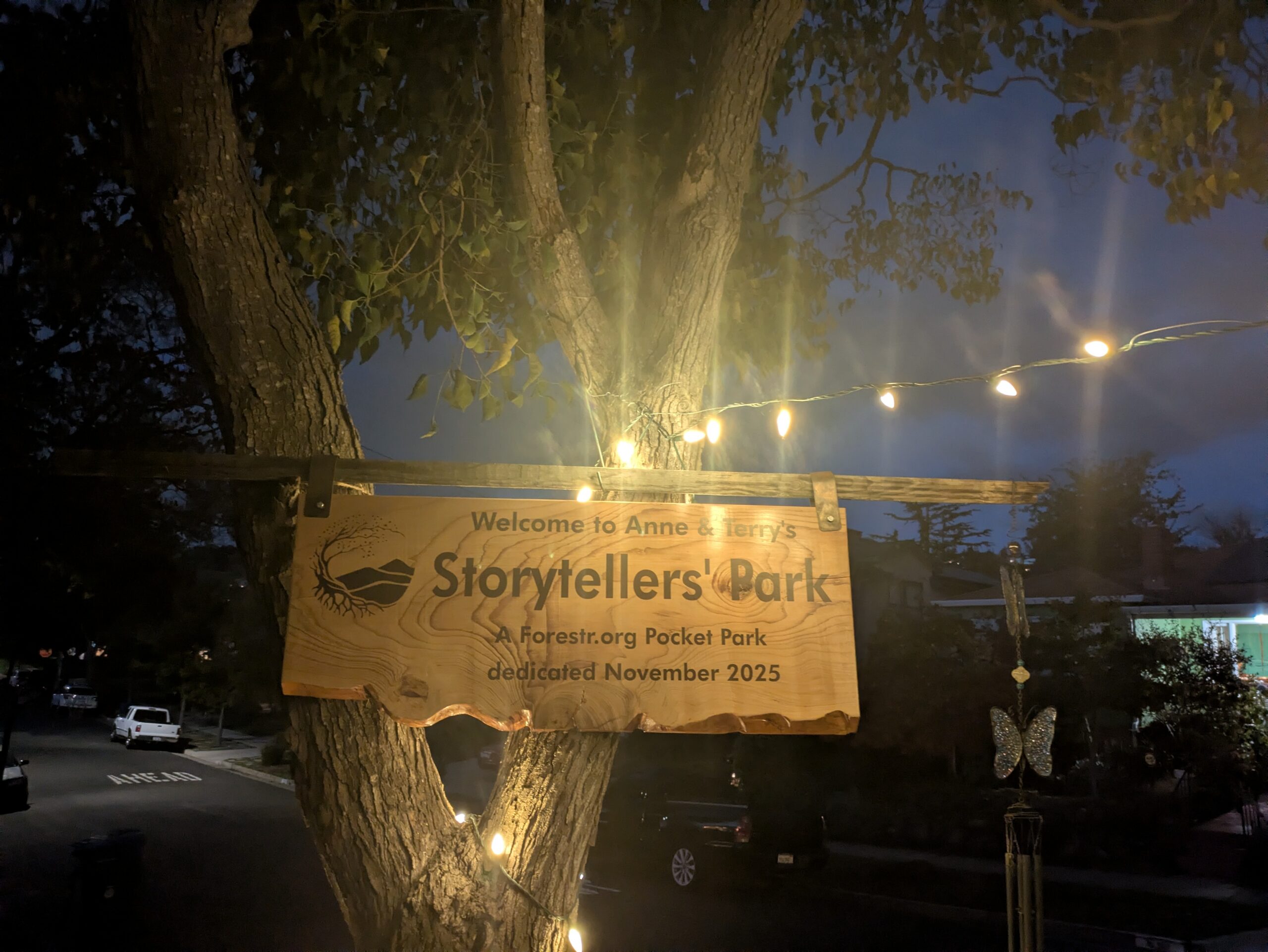
Three years of compost, mulch and natives later, that ground holds water and grows food. A curbside edible garden built entirely from reused materials. Milkweed that raised twenty-odd monarchs this year. Neighbors who stop to taste the strawberries and stay to talk. One of those strips has a name now — Storytellers' Park, dedicated in November 2025, a block from El Cerrito High School on ground that had sat unused for years.
I'd always known the way forward was through the soil. Out there, I remembered it.
What I'm looking for
Alongside building Circular Patterns, I'm open to roles and consulting engagements where the job is to make something coherent out of many moving parts: regenerative agriculture, community and economic development, climate philanthropy, and mission-driven operations, marketing and communications.
What I'm good at is reading a signal before it's obvious, weaving together the people who should be working together, and holding the thing up through a bad year. There's a case study for that here, and the record of the pattern here.
Take it with you
- Web
- LinkedIn profile
Substack
Where the thinking happens before it becomes a framework.
Get in touch
For funders, collaborators, or anyone ready to restore and regenerate their place.
Direct
- tracey@circularpatterns.com
- 415.298.8816
- El Cerrito, California