Systemic transformation requires systemic funding flows. Circular Patterns is ready to build the protocol layer to enable it.
Protocols (not platforms) to match funds to the places ready to do the work. Beginning with soil.
The social layer of the internet was never built. The same thing happened to civic life.
Financial markets filled both gaps with for-profit substitutes. What's missing isn't willingness — communities, practitioners and conservation districts are already restoring land. What's missing is the layer that lets resources find them.
Circular Patterns designs civic and ecological tooling — built on open protocols, not platforms — that helps the people of a place organize around shared ecological values, then restore their land, beginning with soil.
Whether a neighborhood or a cluster of farms, healthy soil that holds water, carbon and biodiversity is the keystone for a healthy community and for living within the ecological limits of the planet.
Circular Patterns is not a replacement for existing systems. It designs the conditions for what replaces them: a layer that sits above individual programs and financial instruments, and that organizes and routes capital to the restoration work already happening on the ground.
A shared way to read a place
Not a project's compliance checklist. A reading of the whole place, against ecological limits and human needs.
In 2017 the economist Kate Raworth published Doughnut Economics — a framework that holds human wellbeing and planetary boundaries in one picture: an outer ring of ecological ceilings, an inner ring of social foundations, and a habitable band between them where a society can actually live.
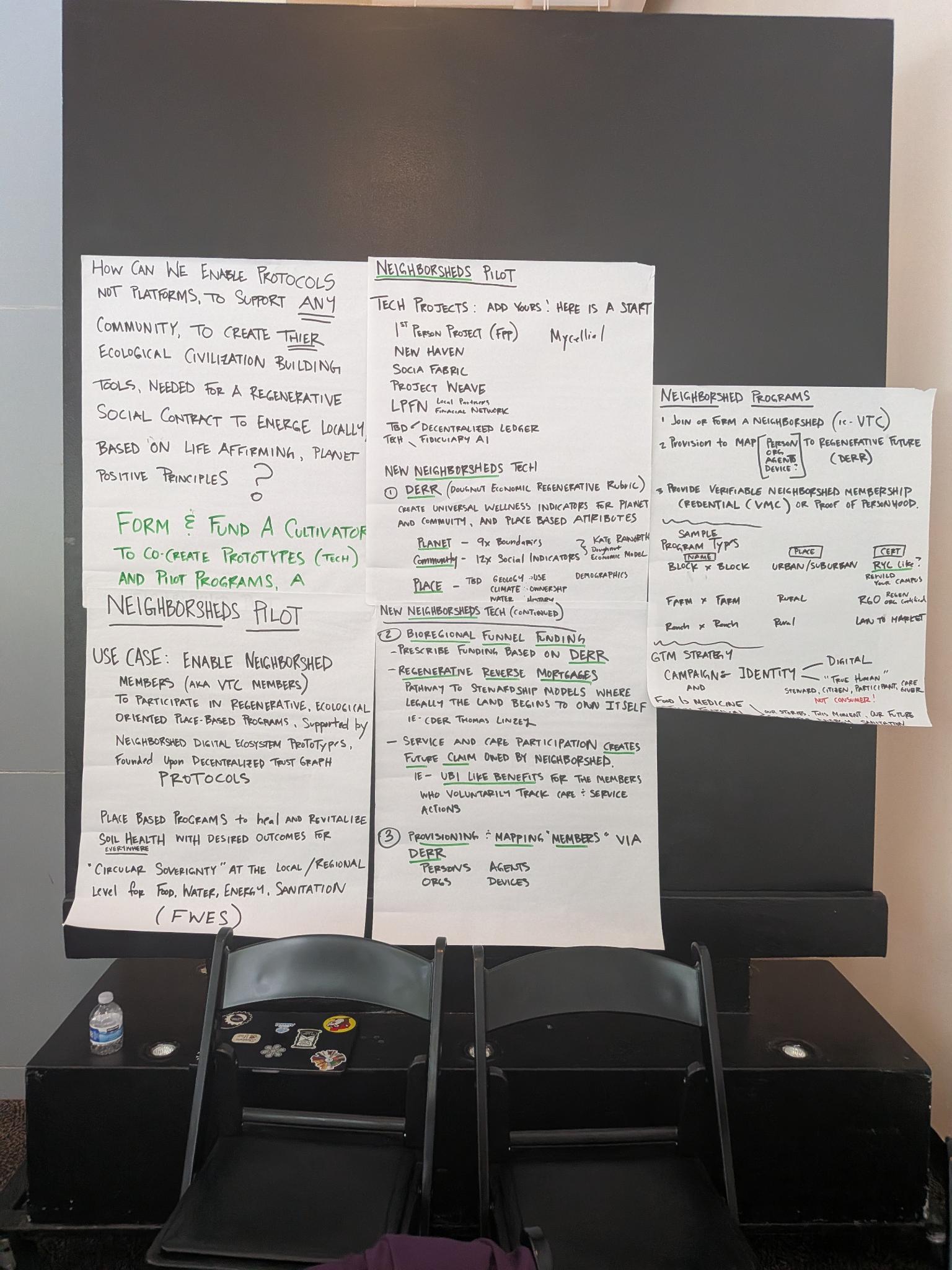
Raworth gave us the shape. What I built on top of it is a way to apply that shape to one specific place — nine biosphere measures, twelve community measures — and turn the reading into something funders and residents can both act on. That's the Doughnut Economic Regenerative Rubric (DERR).
- 01An inventory of the place's assets and liabilities.
- 02An inventory of its people's offers and needs.
- 03An assessment of its regenerative baseline and capacity.
- 04A map of circular production capacity, for regional supply chains in water, food, energy and sanitation.
From that reading the rubric produces regenerative recipes — matching what people can offer to what the place needs. Once a place can be read this way, funding can be directed to it by need rather than by credit rating.
Regenerism
A care-based economic and governance framework, designed to sit beneath individual financial tools rather than compete with them.
The Doughnut Economic Regenerative Rubric (DERR) is one protocol among several in a larger system. Regenerism is the whole of it: six interoperable components that together describe how a place organizes itself, measures itself, establishes trust, and draws what it needs.
Its governance model is federated and repeats at every scale — from a Neighborshed up through county, watershed and bioregion, with a consistent council structure and two-tier dispute resolution at each level. That repetition is deliberate: a model that only works at one scale isn't infrastructure.
None of it is invented from nothing. I'm standing on the shoulders of people who did the hard thinking first — Kate Raworth on doughnut economics, John Fullerton on regenerative economics, Donella Meadows on systems and leverage points, Janine Benyus on biomimicry, and the practitioners behind First Person Project, Project Weave, Common Planet, and many more. My contribution has been the design and weaving, to create the coherence needed, for place-based systemic transformation to become fundable, replicable and scalable.
The six components
- 01
- Neighborsheds — the local unit
- 02
- Federated governance
- 03
- Monitoring rubric (DERR)
- 04
- Trust infrastructure
- 05
- Funding strategy
- 06
- Alternative financial instruments
Join us if you are ready to build a new model.
Soil is the shared ground
Circular Patterns designs the three layers above it.
Resources routed by need
Blended capital matched to a place by what it needs — not its credit rating.
Shared measurement rubric
Reads a place's wellbeing against ecological limits and human needs.
Neighborshed domain
A place and its people, organized around shared ecological values.
Living ground — soil
Restored to hold water, carbon and biodiversity — and grow food.
based on these designs
Ready to build, starting with an alpha pilot
The framework is designed. The practice is proven at parcel and block scale. What's missing is one place, with participating humans, where the two meet — restoring soil on real ground, field-testing the rubric, and producing the participation model that lets the approach be replicated and resourced elsewhere.
It is deliberately scoped to what can be demonstrated honestly: a practice that works, instrumented by a protocol that does not yet exist and that this funding is what creates.
I'm looking for a funder to build it, or a role where this work belongs — or both.
The Research
Three years of study, design, proof on the ground, and clients who needed the same skill pointed at their own problem.
AboutTracey Rogers Brandt
Thirty years of arriving early, and what that record says about the work now.
Before 2023The Gilman District
How a 1906 ink factory became Berkeley's wine block, with references and press.
Get in touch
For funders, collaborators, or anyone ready to restore and regenerate their place.
Direct
- tracey@circularpatterns.com
- 415.298.8816
- El Cerrito, California